
Sudoku Hidden Singles: The Complete Beginner’s Guide
The Sudoku Hidden Singles Technique is one of the first Sudoku solving approaches that every beginner should learn. It is a simple idea but it can be surprisingly easy to miss if you do not know what to look for. In this introduction you will discover what hidden singles are, why they matter so much for solving puzzles, and when to use this strategy during gameplay.
Together with naked singles and full houses, hidden singles belong to the core set of basic Sudoku techniques every new solver should master.
What Is a Hidden Single in Sudoku
A hidden single sometimes called a last remaining cell or pinned digit is a situation where a number has only one possible cell where it can go in a given unit such as a row a column or a three by three block. Within that entire row column or block one specific cell is the only place a certain digit can fit. Because it is the sole spot for that digit it must be the solution for that cell.
The reason it is called hidden is that the cell might have other candidate numbers penciled in so this single possibility is not immediately obvious until you analyze that row column or block carefully.
Imagine a cell that could potentially be a three a five or a seven. If you discover that five can only go in that one cell for the whole row then five is a hidden single for that row. The correct number was hiding among other candidates in the cell and it only becomes clear once you consider the wider context of the unit.
The key idea is that a hidden single is essentially a one per unit situation. It is different from a naked single where a cell has only one candidate number left. In a hidden single the focus is on a digit and its placements across a unit. Only one cell in that unit can contain that digit even if that cell has other notes written down.
Why the Hidden Singles Technique Is So Important
Hidden singles are fundamental to Sudoku solving and are often the very first technique to use when you start a new puzzle. Many easy Sudoku grids can be solved entirely by finding hidden singles. For beginners mastering this technique gives a huge confidence boost and creates a solid foundation for tackling harder puzzles.
Some reasons the Hidden Singles Technique is worth mastering include the following.
- They appear in every difficulty. Even challenging puzzles usually have a few hidden singles at different stages. This technique is essential for solving Sudoku at all levels and you will use it again and again so it really pays to become comfortable with it.
- No special notes are needed. You can find hidden singles through simple logic and scanning without any complicated notation. This makes the method beginner friendly and a great way to begin solving before you move on to more advanced strategies.
- They set up other moves. Spotting a hidden single early often unlocks more progress. Placing that one sure number can remove candidates elsewhere which reveals new singles or simpler patterns. Every hidden single you fill in makes the rest of the puzzle a little easier.
- They teach good habits. Learning this technique trains you to scan systematically and to pay attention to how each number is distributed across the grid. These are excellent habits that strengthen your overall Sudoku solving skills.
How to Find Hidden Singles Step by Step
Finding hidden singles is all about systematic scanning. The basic idea is to choose a number or a section of the grid and look carefully for places where only one option exists for that number. The following step by step approach works very well for the Hidden Singles Technique.
List Out Candidates Optional
For beginners it often helps to pencil in candidate numbers. These are small notes of which digits could go in each empty cell. This is not required but having these notes makes hidden singles much easier to spot because you can literally see when a number appears only once in a row a column or a block. If you prefer not to pencil in you can still find hidden singles through logical scanning which we cover next.
Scan by Number Using Cross Hatching
Choose a digit from one to nine and scan each three by three block to see where that digit could go. Cross hatching is a classic method for this. Imagine or lightly sketch lines through all cells in a block that cannot contain your chosen number because that number already appears in the same row or column. If in any block there is exactly one cell where the number can fit you have found a hidden single for that number in that block. Fill it in at once.
Repeat for All Numbers
Go through each digit from one to nine and scan all blocks for a lone possible cell. It helps to move in order so you do not skip any numbers. Check every block for each digit. Many puzzles will reveal several hidden singles during this sweep.
Expand to Rows and Columns
After checking all the blocks do a similar scan for each row and each column. Sometimes a number does not form a hidden single in any block but within a particular row or a particular column it has only one possible position. Treat every row and every column as a unit and search for a digit that has only one open spot in that line.
Place Numbers and Update the Grid
Each time you identify a hidden single fill that number into the grid. Then update your pencil marks by erasing that number from all notes in the same row column and block because it is now used there. This new placement might create more hidden singles in other units so it is crucial to iterate. After placing any number scan again for new singles. Hidden singles often appear in chains where one leads directly to another.
Stay Systematic
If you go through all nine digits and do not find any hidden single in blocks rows or columns double check your work. It is easy to overlook one especially if you are not using pencil marks. Confirm that you have considered every unit and every digit. If there truly are none then the puzzle probably requires a different technique next and at least you know this simpler strategy has been exhausted.
Hidden Single Examples in Real Sudoku Grids
Example One Hidden Single in a Three by Three Block
Consider the center block of a Sudoku puzzle often called Block Five. Suppose you are looking for the number eight in this block and you notice something important. Every row and column that passes through this block already contains an eight except for one single cell. There is only one empty spot in Block Five where eight can possibly go.
All other cells in that block are ruled out for eight because either their row or their column already has an eight. The remaining cell is a hidden single for eight in this block. It is the only location where eight can appear so that cell must become an eight. You fill it in immediately.
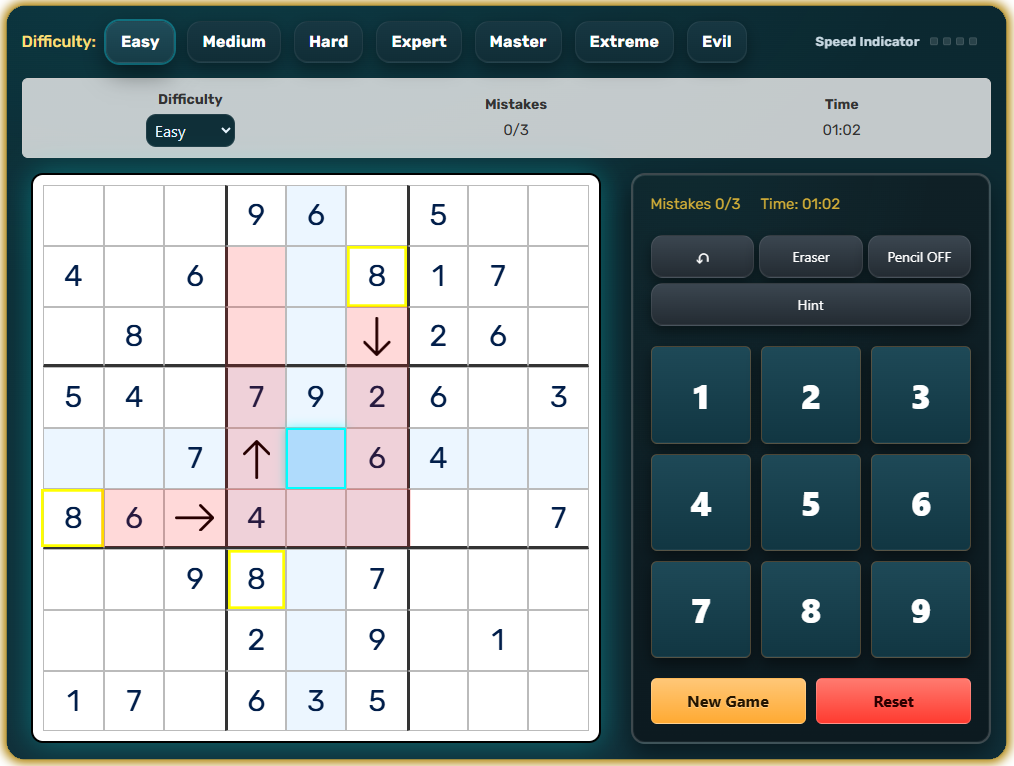
After placing the eight in that cell you would also remove eight from the candidate lists in the same row column and block. Often a single move like this can cause other digits to become hidden singles in their own units. The next step is to scan around the new placement and see what new opportunities have opened up.
Example Two Hidden Single in a Row
Hidden singles do not live only in blocks. You can find them in rows as well. Imagine you are scanning a particular row such as Row Three and checking which digits are missing. Every Sudoku row must contain the digits one through nine exactly once. If Row Three is missing the number sevan and you examine the empty cells in that row asking where sevan could go you might notice that only one cell in the entire row can hold a sevan.
Perhaps all other empty spots in Row Three already see a sevan in the same column or in the same block leaving a single position where sevan is not blocked. That cell becomes a hidden single. Sevan can only go in that one spot so you write sevan there. It does not matter if that cell had other penciled candidates. Since no other cell in the row can take a sevan this is the correct and only solution for that position.
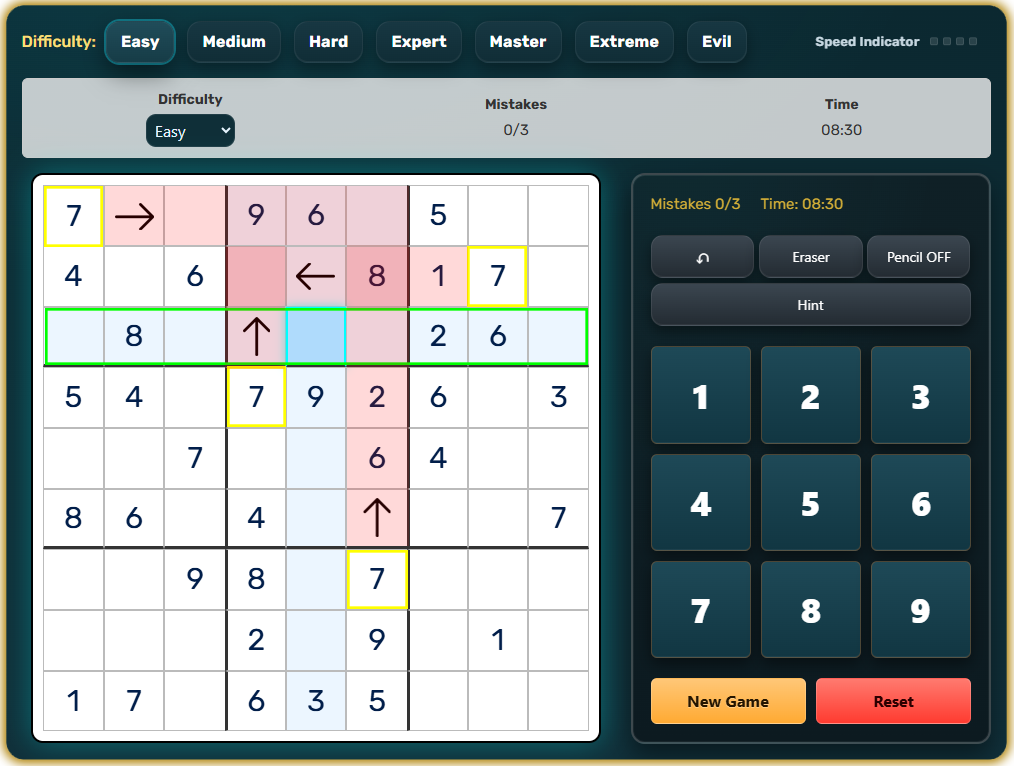
After placing the sevan you will remove sevan from the candidates in the corresponding column and block. This may create new singles elsewhere. Always remember to sweep the puzzle again after placing a hidden single.
Example Three Hidden Single in a Column
The logic for columns mirrors the logic for rows. Take Column Four as an example. Suppose you see that digit five is missing from Column Four so it must appear somewhere in that column. When you check each empty cell in Column Four to see where five could go you may realize that only one cell is viable for a five. Every other empty cell in that column would break a rule because a five already exists in that row or in the relevant block.
That single viable spot is a hidden single for the number five in Column Four. No other cell can accept five without violating a Sudoku rule. You can confidently place the five in that cell.
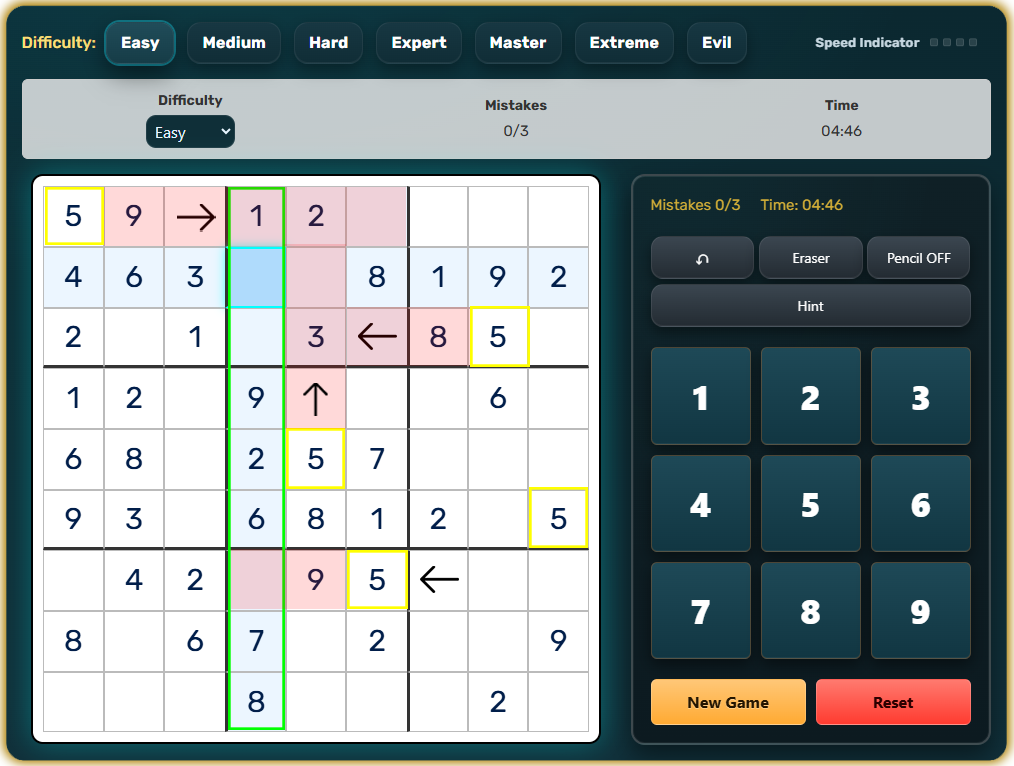
Once again update your candidates and check the surrounding units. This placement might complete a row or a block or set up another hidden single nearby. Every correct single makes the structure of the puzzle clearer.
Tips for Spotting Hidden Singles Faster
Finding hidden singles can feel like searching for a needle in a haystack when you are new. The following tips will help you sharpen your Hidden Singles Technique and speed up your solving.
- Use a systematic approach. Avoid scanning the puzzle at random. Decide on a clear plan. You can scan digit by digit using cross hatching or you can go unit by unit checking each block followed by each row and each column. A consistent routine ensures that you do not skip potential singles by mistake.
- Mark your candidates. If you feel comfortable with pencil marks use them. Candidates turn a hidden single into a very visible single because you will notice when a number appears only once in the notes of a row a column or a block. Many Sudoku apps offer a feature that highlights candidate numbers which can make hidden singles stand out clearly. Use these tools especially while you are learning.
- Focus on nearly complete units. Hidden singles often appear in units that are almost full. When a row already has seven or eight numbers filled in the remaining one or two cells are prime locations to check. With so few gaps it is easier to see if a digit has only a single possible position left.
- Double check each placement. Whenever you believe you have found a hidden single confirm two things. First the number should not already be present in the same row column or block. Second no other empty cell in that unit should be able to take that number. If both checks pass you have a valid hidden single.
- Rescan after every move. Sudoku is dynamic. Every number you place changes the possibilities in the surrounding cells. A cell that was not a hidden single before might become one after another number is placed. After each move especially after every hidden single scan the affected row column and block again. New singles often appear immediately.
At first you may still miss some hidden singles and that is completely normal. With practice your eyes and brain will start to recognize the patterns automatically and the Hidden Singles Technique will feel natural and intuitive.
Hidden Single and Naked Single What Is the Difference
Beginners often confuse hidden singles with naked singles so it helps to draw a clear line between the two. Both are single techniques, meaning they identify a definite number to fill in but they work from opposite directions.
A hidden single is about one possible cell for a number. You focus on a unit such as a row a column or a block and consider a specific digit. That digit can go in only one cell in that unit even if that cell currently shows more than one candidate. The single is hidden among other notes. For example if only one cell in a block can possibly be a seven because all other cells are blocked for seven that cell is a hidden single for the digit seven in that block.
A naked single is about one possible number for a cell. Here you focus on a specific empty cell. After applying all Sudoku rules you find that every digit except one is ruled out by the row the column or the block. The remaining digit is the only choice for that cell. It is called naked because it stands alone without any competition in that cells candidate list.
One simple way to remember the distinction is this. A naked single means only one candidate fits in the cell. A hidden single means only one cell can hold the candidate in the unit. In practice naked singles are usually easiest to see when you use pencil marks because a cell with one note stands out. Hidden singles are often easier to discover by scanning the overall layout and seeing where numbers are missing.
Both techniques are powerful and they often appear together in the same puzzle. Solving a Sudoku by hand usually involves alternating between finding hidden singles and naked singles. Understanding the difference ensures that you apply the correct logic in every situation.
If you are thinking to yourself I wonder which cell in this row can be a five you are hunting a hidden single. If you are thinking this particular cell can only be a five you are looking at a naked single. For beginners hidden singles are usually the first thing to search for and then naked singles come next once you start penciling in candidates. Together they form the core toolkit for logical solving.
Practice Puzzles for the Hidden Singles Technique
The best way to get comfortable with hidden singles is to practice regularly. Here are a few ideas to exercise the Hidden Singles Technique and build confidence.
- Start with easy puzzles. Begin with Sudoku grids that are labeled easy either in newspapers or in apps. These are often solvable using almost nothing but hidden singles and perhaps a few naked singles. Work through the puzzle using the step by step scanning method described earlier and you will usually discover many hidden singles to place.
- Highlight and hunt. Take a partially filled Sudoku grid and choose one number such as all the ones. Mark every place in each block where a one could go. If you notice a block or a row or a column with only a single open spot for that digit you have found a hidden single. This targeted search by number is cross hatching in action and it quickly trains your eye to zero in on singles.
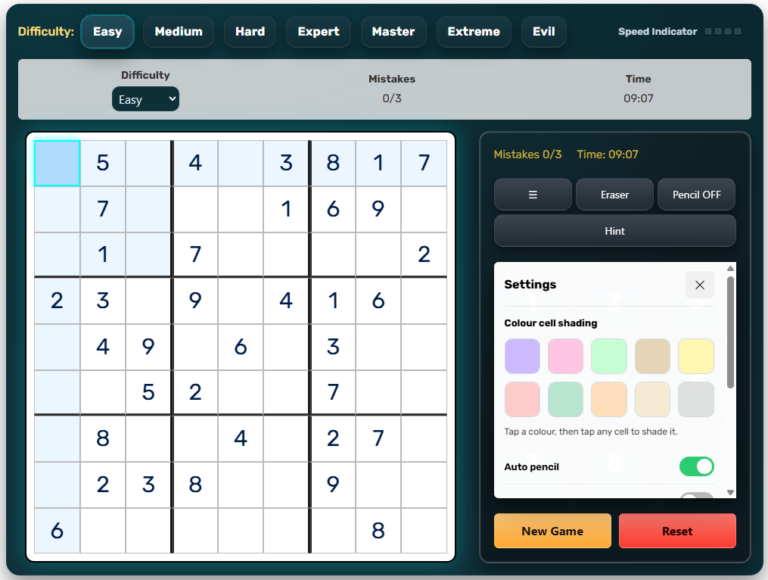
- Use online tools as training wheels. Some digital Sudoku platforms allow you to toggle candidate highlights. You can click on a digit such as seven and the interface highlights every cell where seven is still a possible candidate. If you see a unit where only one highlighted cell remains you have instantly spotted a hidden single. Use this feature to confirm your manual work and to learn the visual pattern.
The long term goal is to reach a point where you can perform this reasoning mentally without any extra aids. As a learning tool though it is perfectly fine to highlight or jot down candidates. Over time you will notice hidden singles more quickly and with less effort.
Common Mistakes to Avoid with Hidden Singles
While learning the Hidden Singles Technique beginners often run into a few common pitfalls. Watching out for these issues will improve your accuracy and make your solving smoother.
- Assuming a single too soon. A cell may look like the only spot for a number at first glance but another viable cell might appear once you check more carefully. Do not rush. Always verify that every other cell in the unit is impossible for that number before you declare a hidden single.
- Mixing up techniques. It is easy to confuse hidden singles with naked singles or other strategies. If you hear yourself thinking there is only one number that can go here make sure the reasoning matches the right technique. For a hidden single the logic should be that no other cell in this row column or block can take this number.
- Forgetting to update the grid. After placing a number especially from a hidden single you must update the rest of the puzzle. If you forget to remove that number from candidate notes in neighboring cells you may incorrectly think another hidden single exists or accidentally place a duplicate number. Keep the grid consistent and remove any impossible candidates as you work.
- Ignoring obvious full houses. Sometimes you can become so focused on searching for a hidden single that you miss an even easier move. A full house also called a last digit is a situation where a row a column or a block has only one empty cell left. You can fill that cell immediately because it must be the number missing in that unit. Even though this is not technically a hidden single it is an easy win and can lead to more singles appearing.
- Feeling stuck when none appear. As puzzles grow harder there will be times when no hidden single is present at the start. This does not mean you have missed something obvious. It may simply mean that another method such as pairs or more detailed pencil marking is needed to move forward. Hidden singles often reappear after a few other logical moves so think of them as valuable gems that pop up repeatedly but not at every moment.
Staying aware of these mistakes will make you a more careful and confident solver. Sudoku rewards patience and clear thinking. If something does not feel right pause for a moment and review your elimination reasoning. With experience you will trust your judgment when using the Hidden Singles Technique and avoid these traps.
Conclusion and Next Steps with the Hidden Singles Technique
Congratulations. You now have a clear understanding of what hidden singles are and how to find them. This technique is a true cornerstone of Sudoku solving. It is straightforward yet incredibly effective. As a beginner mastering the Hidden Singles Technique allows you to solve many easy puzzles from start to finish using nothing more than this method and a bit of patience.
Remember that a hidden single means one number and one possible cell in a unit. The more you practice the faster you will see that lone spot where a digit must go. Soon you will view the Sudoku grid in a fresh way almost visualizing where gaps sit in each row column and block even before you write anything down.
After you feel comfortable with hidden singles the natural next step is to learn about naked singles if you have not already studied them. From there you can explore other strategies such as pairs triples and more advanced patterns like the X Wing. Every new idea builds on the careful scanning habits you developed while working with hidden singles.
Take some time to explore more guides here on Sudoku 4 Adults. Our articles continue to expand your logical toolkit so that every puzzle feels more approachable. Keep practicing various Sudoku grids and deliberately look for hidden singles each time. As your skills grow what once took several minutes of scanning will begin to stand out in seconds.
With the Hidden Singles Technique firmly in your toolkit you are well on your way to cracking puzzles with confidence. Enjoy your solving journey and may all your singles stay hidden until you are ready to uncover them.
Hidden Singles in Sudoku – FAQ
What is a hidden single in Sudoku?
A hidden single is a digit that has only one possible cell in a row, column or 3×3 block, even if that cell still shows other pencil-mark candidates.
Is a hidden single the same as a naked single?
No. A hidden single is the only place a digit can go in a unit. A naked single is the only digit that can go in a specific cell. Both give you a guaranteed placement but from opposite directions.
How do you spot hidden singles quickly?
Use cross-hatching or candidate notes. Scan each block, row and column for digits that appear only once among the remaining candidates. Focusing on nearly complete units makes hidden singles easier to see.
Can every Sudoku be solved using only hidden singles?
Many easy puzzles can be solved with hidden singles (and a few naked singles), but harder grids need additional techniques like pairs, triples and advanced patterns such as X-Wing.