Home » Sudoku News » How to Read a Sudoku Puzzle Like a Pro Using Pattern Recognition
Sudoku4Adults.com
How to Read a Sudoku Puzzle Like a Pro Using Pattern Recognition
Focus Pattern recognitionSkill Reading the gridGoal Solve without guessing
Ever looked at a Sudoku grid and felt lost about where to begin? Solving Sudoku like a pro isn’t about math or guesswork – it’s about
pattern recognition
and logical thinking.
In fact, Sudoku is a puzzle based purely on logic and pattern recognition, not arithmetic. Learning to "read" the puzzle means scanning the grid methodically and spotting clues hidden in plain sight. By recognizing key patterns and using a step-by-step approach, you can dramatically speed up your solving time and tackle even difficult puzzles with confidence.
In this guide, we'll explore how to read a Sudoku puzzle like a seasoned solver
. You'll learn how to scan the grid for patterns, identify common number configurations, and use proven techniques to fill in cells without guessing. This is a comprehensive, educational yet engaging roadmap to mastering Sudoku pattern recognition – perfect for adult puzzle enthusiasts looking to elevate their game. Let's dive in and start seeing Sudoku puzzles through the eyes of a pro!
Why Pattern Recognition Matters in Sudoku
Sudoku
may appear to be about numbers, but it's truly a game of logic and observation.
Every puzzle can be solved through
logic alone
– no guessing required.
What sets expert solvers apart is their ability to quickly recognize patterns and configurations that lead to logical placements. Pattern recognition is essentially the skill of noticing recurring arrangements of numbers or candidates that indicate a specific solving technique. By honing this skill, you reduce trial-and-error and solve puzzles more efficiently.
Pro Sudoku players approach a new puzzle by systematically scanning for these patterns from the start. Rather than filling numbers at random, they read the puzzle almost like a book – identifying which areas are ripe for solving based on the clues given. According to Sudoku experts, knowing even the simplest patterns can “help slice up the grid” and make it much easier to fill in the remaining cells. Recognizing patterns goes hand-in-hand with other fundamental skills like scanning and elimination, and together these methods can significantly improve your solving speed and accuracy.
In short, pattern recognition is the key to cracking Sudoku efficiently. It transforms what might seem like an overwhelming sea of numbers into clear, actionable hints. Once you start seeing the puzzle in terms of patterns – whether it's an obvious single missing number or a hidden arrangement of candidates – Sudoku becomes less about if you can solve it and more about how you'll solve it.
Scanning the Puzzle: Your First Step to “Reading” Sudoku
The first thing any pro does when approaching a Sudoku puzzle is a global scan of the grid. Scanning is a systematic sweep across rows, columns, and 3×3 boxes to spot simple opportunities and
constraints.
Think of it as surveying the battlefield before making a move. By scanning the puzzle, you identify where the easiest placements might be and set the stage for more advanced strategies.
What is scanning? Scanning is essentially the process of observing the puzzle for patterns, repetitions, or gaps that stand out. This could be noticing that a certain number appears in two out of three boxes in a row, or that one row is missing only a couple of numbers. As Sudoku Conquest notes, scanning involves noting patterns, similarities, and differences on the grid – such as repeating numbers in a row, column, or box – to make it easier to place the remaining digits. By doing an initial scan, you can often place a few easy numbers right away and eliminate impossible placements for others.
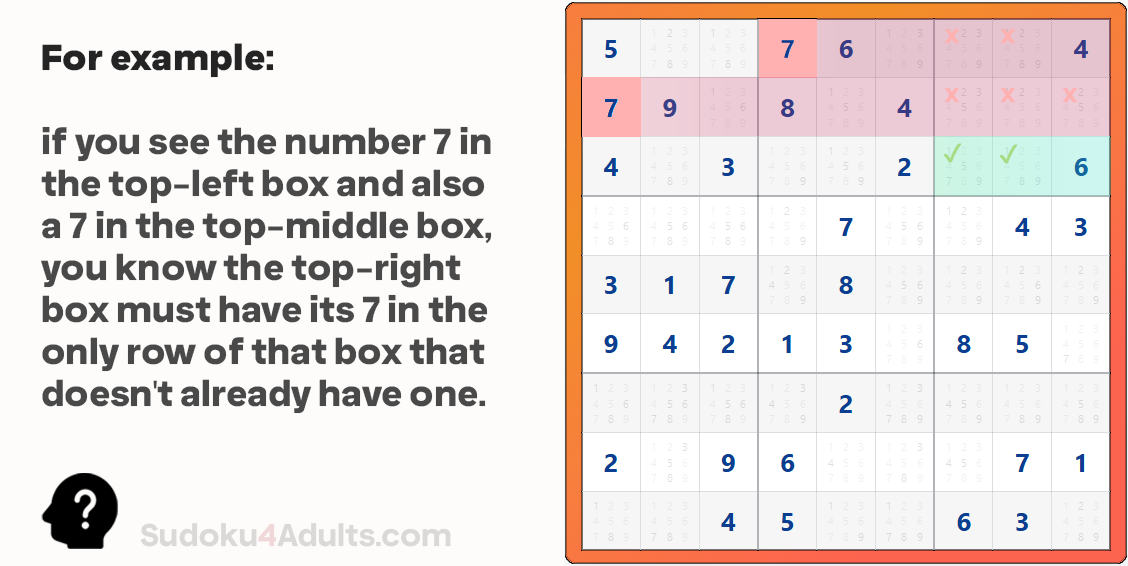
How to scan like a pro: Start by looking at each 3×3 subgrid one by one. For each subgrid, check the surrounding rows and columns for any numbers that repeat. A classic scanning technique is cross-hatching: imagine drawing lines through the grid from each given number to eliminate possibilities in its row and column. For example, if you see the number 7 in the top-left box and also a 7 in the top-middle box, you know the top-right box must have its 7 in the only row of that box that doesn't already have one. Scanning in this way (both horizontally and vertically) often reveals obvious placements. In fact, the easiest way to start a Sudoku is to scan each row, column, and box to find situations where only a single number can fit in a given cell.
Visual Explanation
As you scan, focus on low-hanging fruit. Identify any row, column, or box that is almost complete – perhaps missing just one or two numbers. These are great starting points: if a row has 8 out of 9 numbers filled, you can usually deduce the last one by elimination. Similarly, if a number (say 5) appears in eight of the nine rows, you can often place the 5 in the remaining row by seeing which column and box is missing it.
Remember, scanning is not a one-time step. Continue to scan the puzzle repeatedly as you fill in new numbers. Every time you place a number, it can create new opportunities elsewhere on the grid. By cultivating a habit of constantly scanning and cross-checking, you’ll start to read the puzzle fluidly, with each new placement guiding you to the next.
Basic Patterns to Recognize at a Glance
Once you've scanned the puzzle, the next step is to zero in on some basic patterns that often provide quick wins. These are straightforward configurations that tell you exactly where a number must go. Spotting these patterns is like learning sight words in reading – they should jump out at you with a bit of practice. Let’s look at the most common ones:
Naked Singles: The One and Only Choice
A naked single is perhaps the easiest pattern to spot. It means a cell has only one possible number that can go into it, given the current state of the row, column, and box. In other words, all other digits are already present around that cell, leaving just one option. For example, if a particular cell is the only empty spot in a row and every number except 9 is already in that row, then that cell must be 9. You can fill it in immediately. Naked singles often appear after you've placed a few initial numbers by scanning. Spend the opening minutes of a puzzle looking for these one-option cells – they are freebie answers that require no guessing.
How do you find naked singles? One trick is to pencil in possible candidates (more on pencil marking later) for cells as you scan; if any cell ends up with just a single candidate, that's a naked single. Also, examine any almost-complete unit (row/column/box). If 8 numbers are present, the 9th is a naked single by default. Pros love naked singles because they're guaranteed placements and can break open a stalled puzzle.
Hidden Singles: The Lone Ranger in a Unit
Hidden singles are a bit sneakier than naked singles. A hidden single occurs when a number can only go in one possible cell within a given row, column, or 3×3 box – even if that cell has other candidates penciled in. The single is "hidden" among other possibilities, but logically it's the only choice for that number in that unit. For instance, suppose in one 3×3 box, the number 4 has not been placed yet. If you look at all empty cells in that box and find that only one cell could be a 4 (because 4 is excluded from all other empties by row/column conflicts), then that cell is a hidden single for 4 – it must be 4, no matter what else it might have as candidates.
To spot hidden singles, you often have to consider each number and ask, "Where can this number go in this row (or column or box)?" If the answer is "only here", you've found a hidden single. They require careful scanning of candidates, but they are powerful. Hidden singles are just as important as naked singles for completing easy and medium puzzles. Many times, when you feel stuck, it's because there's a hidden single you've overlooked. Find it, and you'll unlock a new round of placements.
Locked Candidates (Box/Line Interactions)
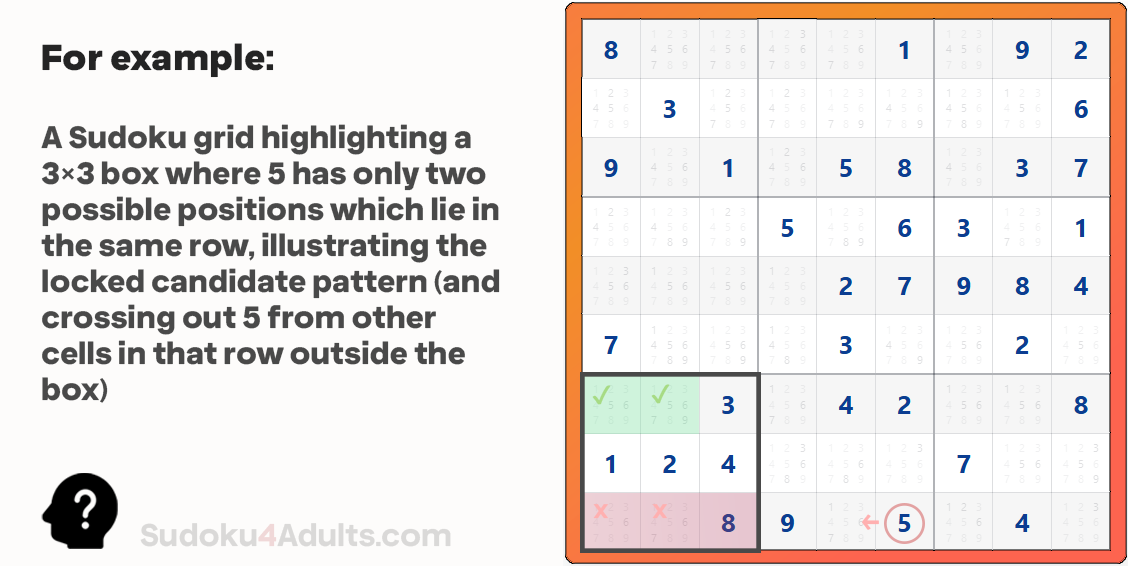
Locked candidates are a pattern that helps eliminate possibilities and are a staple of intermediate Sudoku solving. This pattern occurs when the only possible places for a given number in a 3×3 box lie along the same row or the same column within that box. When that happens, that candidate number is locked into that row/column, meaning it cannot appear anywhere else in that row/column outside of that 3×3 box.
Consider a scenario: in a particular 3×3 box, you determine that the number 5 can only go in two cells, and those two cells happen to be in the top row of that box. This means that elsewhere along that entire top row (in the other boxes), 5 cannot appear in any other cell on that row. You can safely eliminate 5 as a candidate from all other cells in that row outside the box. This is often called the box-line reduction technique: the interaction between a box and a line (row/column) reduces possibilities in other areas.
Locked candidates are a form of pattern recognition that doesn't give you an immediate number to fill, but they dramatically narrow down the field. By eliminating options, they set up more singles or other patterns to emerge. Always be on the lookout for a number that's restricted to one row or column within a box – it's a clue that can simplify the puzzle.
Visual Explanation
Advanced Pattern Recognition Techniques
With the basics under your belt, let's move on to more advanced patterns that skilled solvers use on harder puzzles. These techniques often involve multiple cells and require pencil marks (candidate notes) to spot. They might sound complex at first, but they are all about recognizing specific arrangements of candidates that allow eliminations or placements. Mastering these will truly make you feel like a Sudoku pro.
Naked and Hidden Pairs (and Triples)
Just as single cells can have sole candidates, pairs and triples of cells can form patterns too. A naked pair is when two cells in the same unit (row, column, or box) share exactly the same two candidate numbers – and no other cells in that unit have those candidates. For example, if two empty cells in a row can only be {7, 9} and nothing else, then 7 and 9 must occupy those two cells in some order. As a result, no other cell in that row can be 7 or 9. This eliminates 7 and 9 as possibilities elsewhere in the row, often leading to other placements. Naked triples are the same idea with three cells and three numbers.
A hidden pair is the flip side: when two numbers only appear as candidates in the same two cells (they might have other candidates too, hence "hidden"). For instance, if in a column the candidates for number 2 and 3 are confined to the same two cells (even if those cells have other notes), then 2 and 3 must occupy those cells, and all other candidates in those two cells can be removed. This reveals new singles or simpler puzzle state. The hidden pair behaves like a sole option for those two numbers, hidden among others.
These patterns extend to triples as well (naked triple, hidden triple) where three cells contain only a trio of possible numbers among them. Spotting these requires careful cross-checking of pencil marks, but when you find one, it's like uncovering a secret code in the puzzle. Suddenly, multiple eliminations happen at once, clearing the path for more obvious moves. On very hard puzzles, identifying a pair or triple is often the breakthrough you need.
X-Wing Pattern
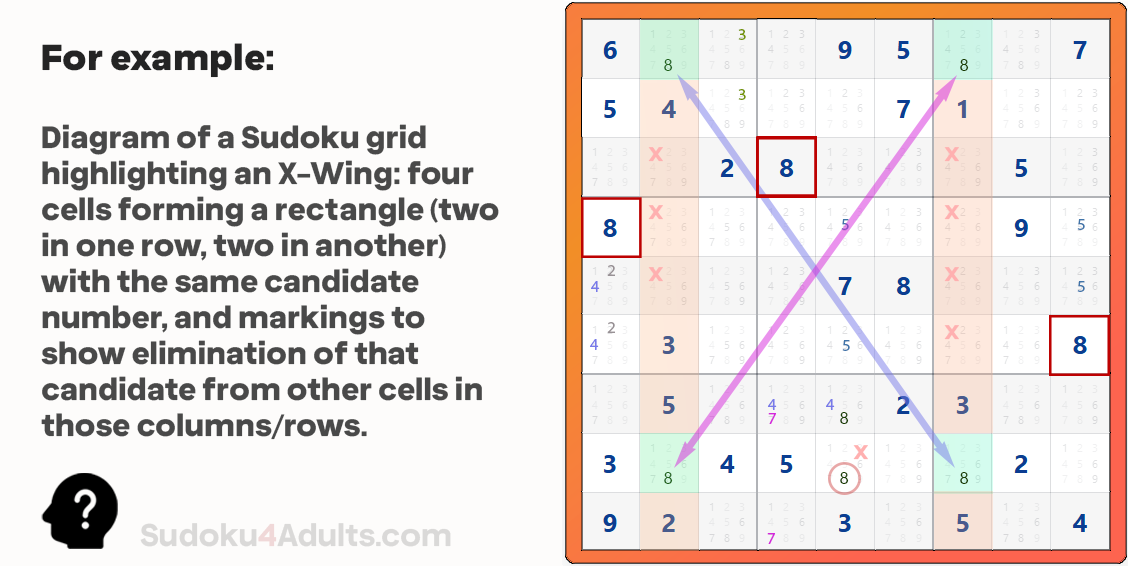
The X-Wing is a famous Sudoku pattern that sounds fancy but can be understood step by step. It gets its name because it involves four cells that form the corners of a rectangle (which looks like an “X” if you draw lines connecting the corners). This pattern arises in the context of a single candidate number. Essentially, an X-Wing occurs when a candidate appears in two possible cells in one row, and the exact same two columns have that candidate in two possible cells in another row – forming a rectangle layout. When you see this, you can eliminate that candidate from all other cells in those two columns and two rows.
Let's break it down with a simple example: imagine the number 8 is a candidate in only two cells of row 1, and those cells are in columns 2 and 7. Now in row 8, the number 8 is also a candidate in exactly two cells, and importantly, these cells are also in columns 2 and 7. You have a rectangle formed by (r1c2, r1c7, r8c2, r8c7). In such a case, we know that in row 1, 8 will eventually occupy one of the two spots (c2 or c7). Likewise, in row 8, 8 will occupy one of its two spots (c2 or c7). Whichever way it happens, the columns 2 and 7 will each definitely have one 8 placed in those two rows. Therefore, no other cell in column 2 or column 7 can have an 8. We can safely eliminate 8 as a candidate from all other cells in those two columns. This elimination often cracks a stalemate in tough puzzles.
The X-Wing is considered an advanced technique because you typically need to use pencil marks to identify it. But once you see the telltale "rectangle" pattern of candidates, it's actually straightforward to apply. And the reward is big – clearing out a candidate from multiple cells can lead to several easy fills afterward. Keep in mind, X-Wings are not very common in easy or medium puzzles, but they do show up in hard puzzles and are a tool every aspiring Sudoku pro should know.
Visual Explanation
Swordfish Pattern
If an X-Wing is good, the Swordfish is its bigger cousin for even more challenging puzzles. A Swordfish involves a pattern across three rows and three columns (hence looking a bit like the fishing net pattern of a swordfish). In essence, a Swordfish is like an X-Wing but extended: it’s a scenario where a candidate number is confined to at most three cells in each of three different rows and those candidates all lie in the same three columns (or vice versa: three columns and three rows). It creates a 3x3 grid of candidate positions.
Here's a simpler description: imagine the number 6 appears as a possible candidate in three different rows of the puzzle. Moreover, in each of those rows, the candidate 6 is limited to the same three columns. This means we have nine potential spots arranged in a sort of rectangle-plus-one shape. If you shade those spots, you see a pattern – the Swordfish. The logic then is similar to X-Wing: these candidates in the three rows and three columns are claiming the positions for the number 6, which locks out 6 from appearing in any other cells in those three columns and three rows. By identifying a Swordfish, you can wipe out a candidate from many cells at once, potentially revealing multiple singles.
Swordfish patterns are more rare and usually only needed for very hard or expert-level puzzles. They are a bit harder to spot, as you're juggling nine cells in your mind (or on your notes) instead of four. But if you practice looking for X-Wings, you can graduate to Swordfish by extending the same idea. Some puzzles that can’t be cracked by simpler means will fall open when a Swordfish is applied. For the ultimate Sudoku enthusiast aiming to read puzzles like a true pro, learning Swordfish is a rewarding challenge.
Other Notable Patterns (Beyond the Basics)
The world of Sudoku techniques is vast, and pattern recognition extends even further for those who venture into expert territory. While we won’t dive deep into these, it's good to be aware of a few more patterns and tactics that top solvers use:
XYZ-Wing: An extension of the XY-Wing technique, involving a three-candidate pattern that can lead to a elimination of a candidate in a tricky cell. It’s another pattern where seeing the relationship between three interconnected cells yields a solution.
Unique Rectangles: A pattern that helps avoid falling into a wrong solution when a nearly completed puzzle could be solved two ways (which a proper Sudoku shouldn’t allow). Recognizing a unique rectangle can prevent a deadly assumption.
Coloring and Chains: Techniques like coloring (marking candidates with colors to follow logical implications) and alternating inference chains (AIC) are more advanced logic chains rather than simple visual patterns. These help in very difficult puzzles by following a chain of if-then logic. They are typically used as a last resort when no clear patterns are visible.
Each of these advanced strategies relies on pattern recognition at its core – seeing which cells and candidates are linked by the rules of the game. As you solve more puzzles, you might naturally stumble upon these patterns or find the need to learn them when basic patterns aren’t enough. Remember, even pros continue learning new techniques for the most fiendish puzzles. The good news is that the majority of daily Sudoku solving doesn’t require going this deep, but knowing that extra layer exists can be comforting for the day you need it.
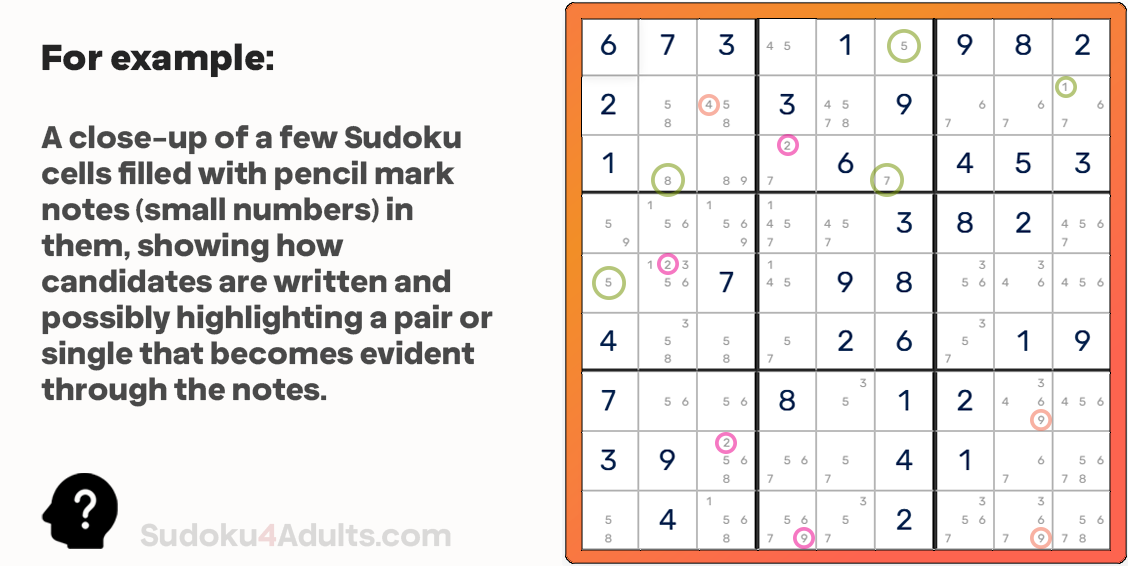
Use Pencil Marks to Aid Pattern Recognition
As puzzles get harder, it becomes challenging to keep track of all possibilities in your head. This is where pencil marks (small notes of candidate numbers in empty cells) become indispensable. Far from being "cheating," pencil marking is a hallmark of skilled Sudoku solving – it’s how you set the stage for spotting patterns that aren't immediately obvious.
When you start a puzzle or reach a point where scanning isn’t yielding easy moves, mark down the possible candidates in some of the emptier cells. You can notate little numbers in the corner of a cell or use an online Sudoku tool’s note feature. The goal is to make the underlying patterns visible. For example, without pencil marks you might not notice that two cells in a box both can only be {2,7}, but with notes, a naked pair pattern jumps out.
Using pencil marks effectively means updating them as you solve: add candidates to empty cells, and eliminate candidates as soon as they become impossible. Over time, your notation will reveal configurations like the pairs, triples, X-Wings, etc., that we discussed. One tip is not to over-clutter every cell with every number – focus your notes on cells or areas that seem constrained or complex. This keeps the puzzle readable. Pencil marks are a "vital visual aid" that help you track potential numbers and spot patterns at a glance, essentially allowing you to read the puzzle more deeply.
Visual idea
Many Sudoku solvers develop their own style of notation. Some fill every possible candidate in each blank cell; others only mark two or three likely candidates. As you practice, you’ll find what works best for you. The important thing is that pencil marks externalize the puzzle’s information, freeing your mind to spot the patterns formed by these candidates instead of trying to juggle them mentally. This is exactly how advanced solvers tackle difficult puzzles systematically.
Practice and Next Steps: Sharpening Your Skills
Reading Sudoku puzzles like a pro is a skill honed with practice. The more puzzles you solve, the more familiar these patterns will become. Here are some tips and resources to help you level up your Sudoku pattern recognition:
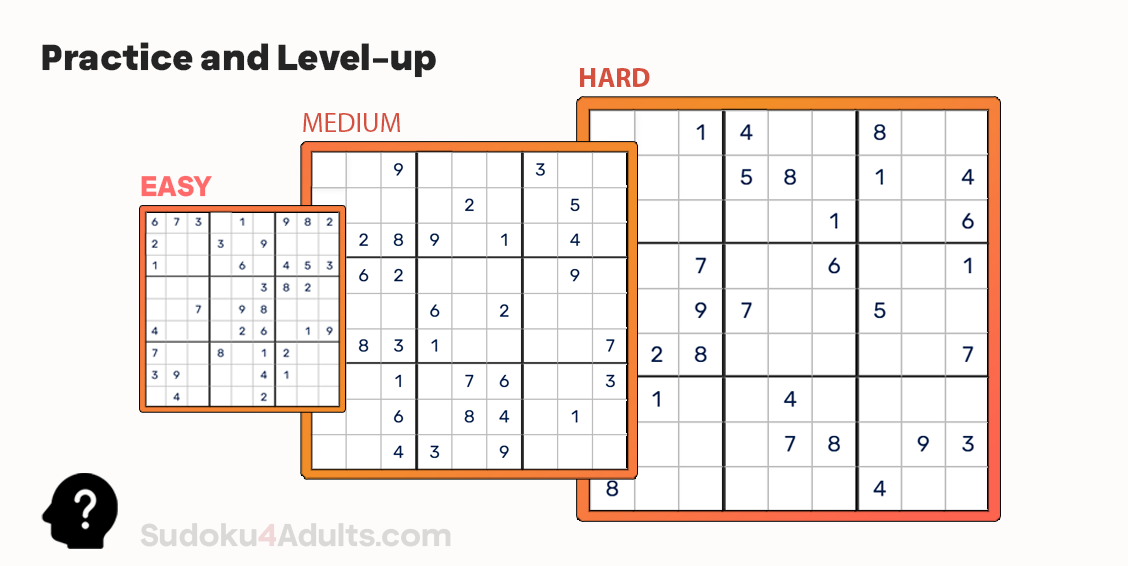
Start Simple and Build Up: If you're new to pattern-based solving, begin with plenty of practice on easy puzzles
to reinforce basics like scanning and singles. Try a collection of easy Sudoku puzzles to get comfortable identifying simple patterns quickly. As you improve, graduate to medium Sudoku puzzles
and eventually hard Sudoku puzzles. This step-by-step increase in difficulty ensures you steadily incorporate new patterns into your solving repertoire without getting overwhelmed.
Use Printable Puzzles for Offline Practice: Sometimes working with pencil and paper can help cement techniques. You might find it beneficial to print out puzzles and solve them by hand, highlighting or marking patterns as you spot them. Our repository of printable Sudoku puzzles
is a great place to find grids you can scribble on. On paper, you can physically draw lines to scan, circle pairs, or cross out eliminations – a tactile way to train your pattern recognition skills.
Leverage a Sudoku Solver (Wisely): While you should avoid guessing, using a solver tool can be educational if used correctly. When you’re absolutely stuck, input the puzzle into a Sudoku solver and have it show the next move or the full solution. Don’t just copy the answer – instead, study what the solver did. Often, it will highlight a pattern or logic step you missed (maybe a hidden single or an X-Wing you didn't spot). This can be a valuable learning moment to improve your skills. Over time, you’ll rely on solvers less and less, but they can serve as a helpful tutor to explain tough patterns.
Observe and Learn: Every puzzle you solve (or even the ones you don’t solve completely) is an opportunity to learn. If you had to guess or got stuck, later review the puzzle to see if there was a logical pattern you overlooked. Perhaps there was a locked candidate you missed or a pair that wasn’t obvious at first glance. Many advanced solvers maintain a reflective approach, analyzing their solving path to catch any mistakes or missed patterns, thus ensuring continuous improvement.
Consistency is Key: Like any skill, consistency matters. Try to solve Sudoku regularly – daily if possible. Each day’s puzzle is like a mini-workout for your brain’s pattern recognition muscles. Over time, patterns that once took you minutes to decipher will pop out in seconds. You’ll find yourself thinking, "Oh, I've seen this situation before!" and knowing exactly what to do.
Visual idea
By now, you should have a clearer understanding of how to read a Sudoku puzzle like a pro. It comes down to a mix of patience, technique, and practice. You start by scanning for the obvious, then methodically work through basic patterns, and eventually deploy advanced techniques if needed. Remember to use pencil marks to keep track of complex patterns and steadily challenge yourself with harder puzzles as you improve.
Sudoku is a journey of pattern discovery. Every puzzle solved reinforces your ability to see the hidden structure beneath the numbers. With these strategies in your toolkit, you'll not only solve puzzles faster but also appreciate the elegant logic that makes Sudoku so satisfying. So grab a puzzle (or open one of our daily Sudoku challenges for a fresh game), and start reading it like a pro – pattern by pattern, you’ll crack it in no time. Happy solving!
Practice on Sudoku4Adults.com
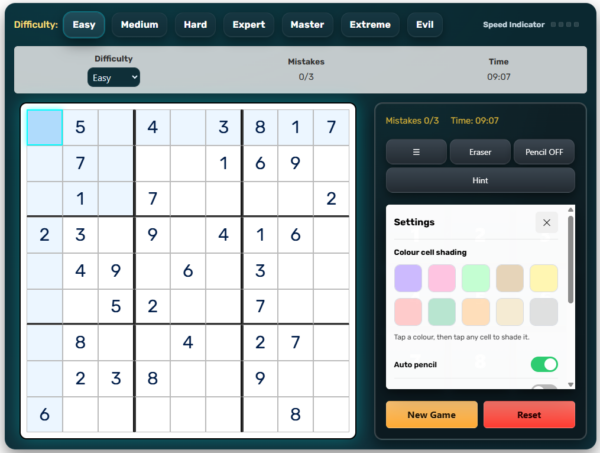
Want to put these reading skills into action right away? Choose a difficulty or use the solver as a learning tool.
Start by scanning for rows, columns, or 3×3 boxes that are almost complete, then look for naked singles and hidden singles. A quick global scan often reveals the first easy placements.
What is the best way to read a Sudoku grid?
Scan box by box, then cross check the surrounding rows and columns. Look for missing numbers, repeated digits, and places where a number can only fit in one cell.
Why do some Sudoku puzzles feel harder even if they are labeled easy?
Difficulty labels vary by publisher and by how the puzzle is constructed. Some grids hide the next logical step more subtly, so you may need better scanning and pattern recognition even though the puzzle uses simple techniques.
Can Sudoku be solved without guessing?
Yes. Properly designed Sudoku puzzles have a unique solution that can be reached through logical elimination, scanning, and pattern based techniques rather than trial and error.
How can you get faster at Sudoku over time?
Speed comes from repetition and familiarity. Solve regularly, improve your scanning habits, and review puzzles you found difficult so the key patterns become easier to spot next time.
Speed meets precision meets leaderboards. The months fastest times are immortalized on the leaderboard. Think you’ve got what it takes? View The Fastest Players
Earn recognition for how you play. From mastering different Sudoku levels to hitting milestones. Collect awards that showcase your skills. View Your Collection Here
Printable Sudoku Puzzles. Grab your favorites and play anytime, no screens required. Great for travel, classrooms, or quiet time. Download & Print Instantly
Free Sudoku Solver Tool. Stuck on a puzzle? Instantly solve any Sudoku with ease, just enter the numbers and let the solver do the rest. Try the Solver Now
Sudoku Rules. New to Sudoku or need a refresher? Learn the simple rules that make Sudoku so addictive. Perfect for beginners and seasoned players. Learn How to Play
Want to solve Sudoku faster without guessing? Learn how to read the grid like a pro using pattern recognition, from smart scanning and singles to pencil marks and advanced patterns that unlock harder puzzles.
Sudoku4Adults Version 2.7 introduces powerful new tools including Dark Mode, Auto Pencil, colour cell shading, puzzle SE ratings, and hardest technique insights — designed to help players solve smarter and play with confidence.
Research links this activity with cognitive scores similar to people up to 10 years younger. Discover why it keeps appearing in brain-aging studies, and how adults 50+ can use it strategically.