
Naked Single Sudoku Technique: The Ultimate Beginner’s Guide
Introduction
Stuck on a Sudoku puzzle and not sure which move to make next? The Naked Singles Sudoku technique might be your new best friend. For anyone exploring Sudoku techniques for beginners, the naked single strategy offers a straightforward yet powerful approach to progress in a puzzle without guessing. It’s often one of the first Sudoku solving tips that experienced players pass on, and for good reason: naked singles are easy to understand and can break open even a stubborn puzzle when spotted. In this guide, we’ll demystify the naked single, show you how to identify these lone solutions, and walk through a naked singles Sudoku example step by step. By the end, you’ll be filling in those one-option cells with confidence.
What Is a Naked Single in Sudoku?
A naked single (sometimes just called a “single” or “sole candidate”) is a situation where an empty cell can only be one possible number based on the current state of the board. In every Sudoku, each empty cell could theoretically be one of several numbers – but if you examine a particular empty cell’s row, column, and 3×3 block, you may find that all but one digit are already present somewhere in those units. When every other number except one is ruled out for that cell, the remaining number has no competitors: it must go in that cell. The term “naked” is used because this single possibility is exposed with no other candidates to hide behind (unlike a " hidden single ” where a lone solution is camouflaged among other penciled-in candidates).
Think of it this way: imagine a cell that hasn’t been filled in yet. Now, list out all the numbers 1 through 9. If you look at the cell’s row, column, and block and see, for example, that the digits 1, 2, 3, 4, 5, 6, 7, and 8 are all present in those peers, what’s missing? Only 9. That means 9 is the only possible number that can go into that empty cell. You’ve discovered a naked single! Because every other candidate number is eliminated by the Sudoku rules, that lone number is a guaranteed fill for the puzzle.
Naked singles are a fundamental solving technique because they don’t involve any complex reasoning or guessing – they’re pure logic. Whenever you find one, you can place that number with 100% certainty that it’s correct. They often appear after you’ve placed a few other numbers or used other basic strategies (like hidden singles), helping to accelerate your progress. Next, let’s talk about why these naked singles are so important and how they fit into your overall Sudoku solving strategy.
Why Are Naked Singles So Important?
Naked singles are more than just easy fills – they’re a cornerstone of good Sudoku solving. Here are a few reasons why mastering the naked single technique will boost your puzzle-solving prowess:
- They appear at every level: Even the toughest Sudoku puzzles often have a naked single or two hiding in them at some stage. In easy puzzles, you’ll find lots of naked singles early on. In hard puzzles, other techniques might reveal a naked single later. No matter the difficulty, this strategy remains useful throughout the solving process.
- Immediate and certain progress: When you spot a naked single, there’s zero doubt about placing that number. You don’t need complex analysis or guessing – it’s a guaranteed correct move. Each naked single you fill in brings you one step closer to the solution and can break open a stalled puzzle, giving you momentum.
- Triggers a domino effect: Placing one number can simplify the rest of the board. Every time you fill in a naked single, you remove that number from the list of possibilities in its entire row, column, and block. This often causes other cells to suddenly become naked singles or at least narrows down possibilities elsewhere. One find can lead directly to another, creating a satisfying chain reaction of solved cells.
- Builds a strong foundation: For beginners, learning naked singles (along with hidden singles) provides a solid base to tackle Sudoku. These singles techniques alone are enough to solve many easy and medium puzzles completely. Even when puzzles get harder, having the habit of checking for naked singles means you’ll never overlook the obvious moves. It trains you to systematically eliminate possibilities and reinforces the fundamental logic that more advanced strategies will build upon.
How to Find Naked Singles (Step-by-Step)
Finding naked singles is a matter of systematically checking cells for lone possibilities. There are two main approaches: using pencil marks (small notes of possible candidates in each cell) or scanning using logic alone. We’ll combine both methods in this step-by-step guide:
- Mark the candidates (optional but helpful): First, if you’re comfortable, go through all empty cells and pencil in all possible numbers that could fit each one. This means writing the numbers 1–9 lightly in a cell’s corner or using an app’s note feature, excluding any digits that are already present in that cell’s row, column, or block. After this, any cell that shows only a single candidate in its notes is immediately a naked single – you can fill that number in right away. (If you prefer not to use notes, you can skip this step and find naked singles by pure scanning, it’s just a bit more effort.)
- Check for “full houses”: Before diving into detailed scanning, quickly scan each row, each column, and each 3×3 block to see if any of them have only one empty cell remaining. If you find such a case, that last empty cell is a guaranteed single – all other numbers in that unit are filled, so the lone missing number must go in that cell. Fill it in. This is a special easy case of a naked single (sometimes called a “last digit” or “full house”). It’s basically a freebie, but it’s worth doing since it simplifies the puzzle immediately.
- Scan each empty cell: Now focus on the remaining empty cells one by one (if you penciled in candidates, you’ve effectively done this already). For each empty cell, look at all the numbers already present in its row, its column, and its 3×3 block. These existing numbers cannot be candidates for the cell. By process of elimination, figure out which digits from 1–9 are missing in those neighbors. If only one number is missing, then that cell has only one possible candidate – you’ve found a naked single! For example, if an empty cell’s peers contain every number except 4, then 4 is the only choice for that cell.
- Place the number and update: Whenever you identify a naked single, write that number into the cell as a solved value. Then make sure to update your pencil marks (or mental notes) in all related cells: remove that number from the list of possible candidates in the same row, the same column, and the same block as the filled cell. This step is crucial because placing a number changes the possibilities for many other cells – and it might create new naked singles elsewhere on the board.
- Repeat the scan: After filling in a naked single and updating the board, start the scanning process again. Often, solving one cell will cause another cell to become a naked single due to the new elimination. Continuously cycle through the empty cells, looking for any new singles that appear. It’s like peeling an onion layer by layer: each number you place can reveal another obvious placement.
- No naked single left? Try another technique: If you’ve scanned all empty cells and none have a single possibility, then there are no naked singles at the moment. Don’t worry – this is common in mid-solve, especially as puzzles get harder. At this point, you might need to switch tactics: look for hidden singles, consider examining pairs or other strategies, or add pencil marks if you haven’t already. Often, using another technique will eliminate a candidate or two and suddenly create a naked single where there wasn’t one before. Remember to always return to this basic check whenever you make progress using other methods.
Example: Naked Single in Action
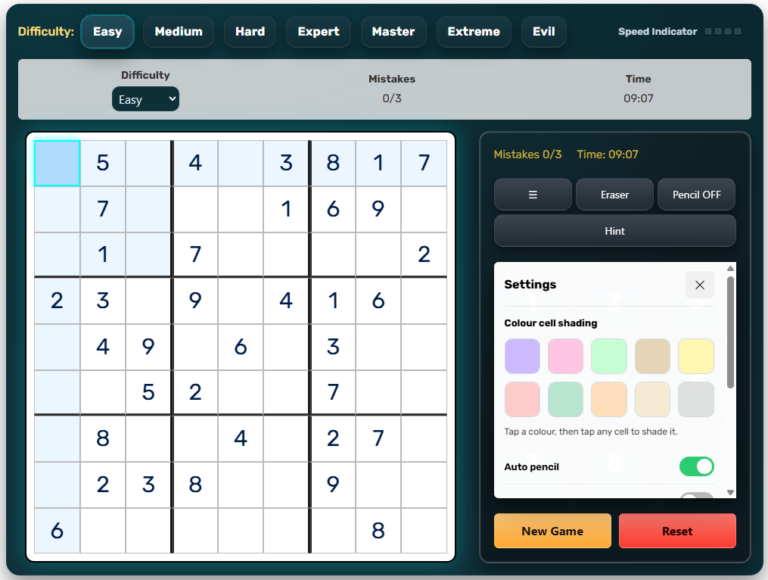
Let’s walk through a quick example to solidify the concept. Imagine a Sudoku puzzle where you’ve made some progress and now there’s a particular empty cell that catches your eye. You examine this cell’s row, column, and 3×3 block, and you notice something exciting: every number except 5 is already present in those related places. In the row of that empty cell, perhaps you see digits like 1, 2, 7, 8, 9 all filled in; in the same column, maybe 3, 6, 7 are present; and in its 3×3 block, you see 1, 4, 8 among others. After checking all these peers, the number 5 is the only digit from 1 through 9 that you haven’t seen. This means that empty cell must be a 5 – no other choice is left! You’ve identified a naked single.
Once you fill in that 5, the puzzle immediately updates. Placing the 5 means no other empty cell in that cell’s row, column, or block can be a 5 now, which further narrows down the possibilities in those areas. Often, filling one naked single will make other cells suddenly resolve as well. For instance, maybe another cell in the same row now has only one candidate left after 5 is removed from its options, giving you a new naked single to place. This chain reaction is why finding a naked single can feel so satisfying – one placement leads to another, and the solution unfolds step by step.
Tips for Spotting Naked Singles
Identifying naked singles becomes easier with practice. Here are some tips to help you spot them more efficiently:
- Pencil in your candidates: If you haven’t already, use pencil marks to list possible numbers in each empty cell. This makes naked singles pop out visually – you’ll literally see a cell with just one number in its notes. That’s a naked single waiting to be placed. As you get more experienced, you might do this elimination in your head, but writing them down (or using an app’s candidate feature) is a great way to train your eye.
- Be systematic, not random: Don’t just scan the puzzle haphazardly. Have a plan for checking cells. For example, you might go through each cell one by one, or sweep through the grid row by row, or focus block by block. You could also try a digit-focused scan (though that approach is more common for hidden singles). The key is to cover all cells methodically so you don’t accidentally skip over a single-candidate cell.
- Target nearly-complete units: Rows, columns, or blocks that are almost filled in (with just one or two empty cells) are prime hunting grounds for naked singles. If a unit has only one empty spot, that’s the easiest find (a full house). Even with two empties, you might be able to determine which number goes where by elimination. The more filled a unit is, the fewer possibilities for each empty cell – making a naked single more likely.
- Double-check before you place: When you think you’ve found a naked single, pause and verify it. Make sure you truly have ruled out all other digits for that cell. Is the candidate number you’re about to place absent from the cell’s row, column, and block? Did you double-check that no other number could possibly fit there? Taking a second to confirm saves you from mistakes caused by an oversight (like missing a number that was actually not present elsewhere). A correct naked single will hold up under scrutiny.
- Update and scan again: Every time you fill in a cell, remember that it changes the puzzle. Get in the habit of removing that number from the candidate lists of its peers right away (if you’re using notes). Then scan the puzzle again for any new naked singles created by that placement. This iterative process – place a number, update, scan again – is a fundamental rhythm of Sudoku solving. You’ll catch a lot more singles if you consistently re-scan after each move.
- Leverage solving tools (for practice): Some Sudoku apps or online sites have features to highlight single candidates or even auto-fill easy singles. While you shouldn’t rely on these tools to solve for you, they can be very useful for training. Try toggling a “show single” feature to check if you missed any naked singles, or to see how quickly you can identify them on your own. Over time, you’ll develop an intuition for noticing when a cell is ripe to be solved.
Common Mistakes to Avoid
Even with a concept as straightforward as naked singles, there are a few pitfalls beginners should be mindful of. Avoid these common mistakes to keep your solving on track:
- Assuming a single too soon: It’s easy to jump the gun and declare a cell a naked single without fully checking all possibilities. Maybe you see only one pencil mark in a cell and think it’s solved, but did you ensure you didn’t miss a candidate? Always verify that every other number 1–9 is indeed present in the row, column, or block. If even one other number could fit, then it’s not a true naked single yet. Patience and thoroughness are key – double-check your eliminations so you only fill a cell when you’re absolutely sure.
- Mixing up techniques: Naked singles and hidden singles often get confused. Remember, a naked single is about one cell having one possible number left. A hidden single is about one number having one possible cell in a unit. If you’re saying “this cell can only be a 3,” you’re using the naked single logic (eliminating other numbers from that cell). If you’re saying “the number 3 can only go in this cell in the row,” that’s hidden single logic. Make sure you’re clear on which strategy you’re applying, so you don’t mis-label a situation and fill in a wrong number.
- Not updating your notes: After you place a number, failing to remove it from the candidates of peer cells can cause confusion and errors. For instance, you might inadvertently leave a ‘5’ penciled in a cell’s notes even though you placed a 5 in the same block already. This could lead you to incorrectly think that cell has two candidates, or conversely, you might overlook a naked single because your notes were inaccurate. Keep your pencil marks consistent and up-to-date after every placement.
- Missing the obvious single: Sometimes you can be so focused on an advanced technique or scanning for something tricky that you overlook a very obvious naked single staring at you. This often happens in the form of the last empty cell in a row/column/block (the “full house” scenario). Make it a habit, especially whenever you get stuck, to do a quick sweep for any cells with only one possible number. It sounds obvious, but many solvers (even experienced ones) can miss a naked single in the heat of solving. Taking that moment to check can save you frustration.
- Getting discouraged when none are found: As puzzles get harder, you’ll encounter stretches where no naked singles are available. This doesn’t mean you’re doing something wrong or that you’ve hit a dead end – it just means another technique needs to come first. Maybe you need to find a hidden single, use a pair elimination, or add some pencil marks. Don’t give up or start guessing randomly because you can’t find an immediate single. Solve a bit more using other methods, and soon a naked single may appear. They tend to pop up again once you make some headway with different strategies.
Conclusion and Next Steps
By now, you should have a solid grasp of what naked singles are and how to use this technique to solve Sudoku puzzles. This simple strategy is a true workhorse of Sudoku solving – straightforward, logical, and incredibly effective. Remember, a naked single means one empty cell with only one possible number left for it. It’s a technique you’ll rely on again and again, and with practice, spotting these lone candidates will become second nature.
As a beginner, mastering the naked single (along with the hidden single) gives you the power to solve many easy and medium medium puzzles start to finish. It’s a huge confidence booster when you realize you can crack puzzles using pure logic and without any guessing. Make it a habit to always look for these singles; often they are the key that unlocks the next stage of a puzzle.
Where to go from here? If you haven’t already, be sure to read our guide on the hidden single technique – it complements what you learned here, since hidden and naked singles often work hand-in-hand during a solve. Together, those two are the foundation of solving. Once you’re comfortable with singles, you can move on to more advanced strategies like naked pairs, hidden pairs, X-Wings, and beyond. Don’t be intimidated by the fancy names – many of the harder techniques are just extensions of the same logical principles you’ve been practicing, like eliminating possibilities and finding “only choices” in clever ways.
We have plenty more Sudoku solving tips and articles on Sudoku 4 Adults, so feel free to explore and expand your skills. Each new technique you learn will build on the habits you’ve formed here, making you a sharper solver. Keep practicing, and with each puzzle, you’ll get faster and more accurate at spotting those naked singles and other patterns.
Most importantly, enjoy the process! Sudoku is as much about the journey as the solution. With naked singles now in your toolbox, you’re well on your way to conquering puzzles with confidence. Happy solving, and may you always find that lone number waiting to be discovered!