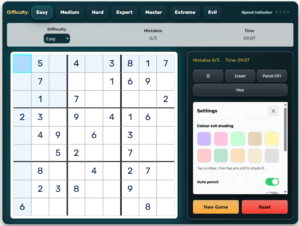
Why Is AI Escargot So Difficult?
What makes AI Escargot stand out is the sheer complexity of logical reasoning required to solve it. Inkala designed this puzzle to push human solving techniques to their limits. He famously explained that “Escargot demands [solvers] to consider eight causal relationships simultaneously, while the most complicated variants attempted by the public require people to think of only one or two combinations at any one time”. In other words, at many points you must juggle eight different interlinked logic threads at once – a far cry from ordinary “very hard” Sudokus that might involve just a couple of simultaneous constraints. This forces solvers into extremely deep reasoning and uncommon strategies.
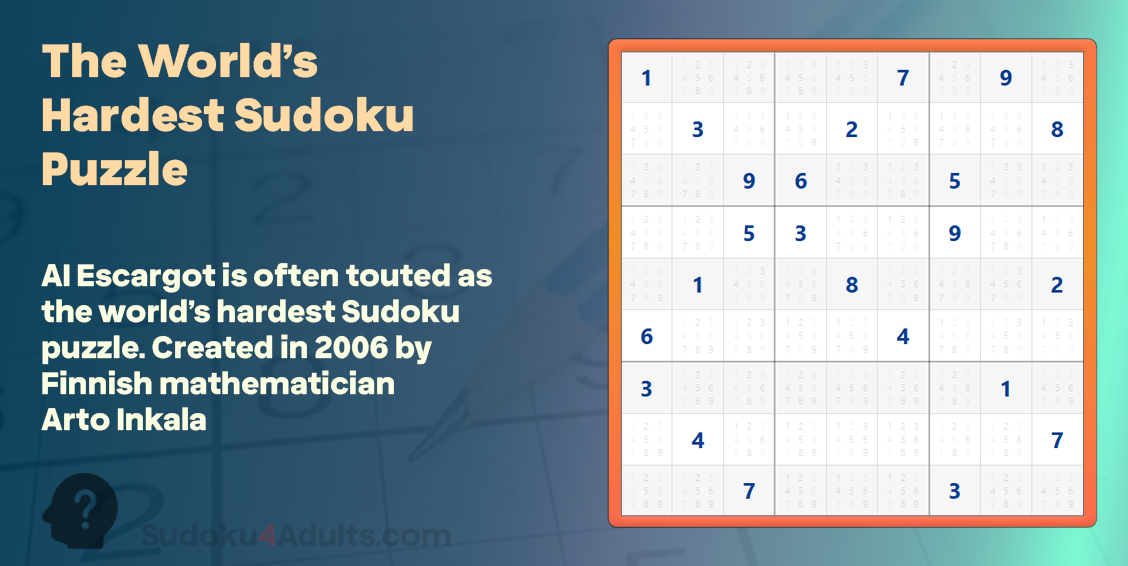
Notably, AI Escargot isn’t the easiest puzzle in terms of given clues, but it’s engineered for maximum difficulty. It provides 21 clues (starting numbers) on the 81-cell grid – more than the absolute minimum 17 clues required for a valid Sudoku, yet arranged in a devious way. The positioning of these givens creates the snail-shaped pattern and ensures that very few moves are obvious at the start. In fact, Inkala noted that the puzzle’s difficulty “lies in the number of logical deductions needed to fill a single box”. As a result, almost no cell can be solved with basic methods alone. A typical difficult Sudoku might yield a few easy placements before requiring advanced techniques, but with AI Escargot you often hit a wall immediately – every progress step demands elaborate inference or testing of possibilities.
Another indicator of its extreme complexity is its difficulty rating. On the usual 5-star scale (where 5 stars is “fiendish”), AI Escargot has been estimated at 11 stars – essentially off the charts. In practical terms, that means it’s roughly twice as hard as the hardest puzzles featured in newspapers. Even computer-solving programs struggle: a standard Sudoku solver loaded with common logical strategies cannot crack Escargot at all. It requires either brute-force search or incorporating highly advanced solving techniques beyond the norm. Puzzle enthusiasts report that solving Escargot logically involves chaining together numerous exotic strategies (forcing chains, advanced pattern eliminations, etc.) with no margin for error, making it a formidable trial-and-error exercise for all but the most expert solvers. If you get stuck, you can try our
Sudoku solver.
The “Snail” Pattern and Puzzle Layout
AI Escargot’s initial grid of clues, arranged in a distinctive “snail shell” pattern. The given numbers (21 in total) spiral inward across the 9×9 grid, which inspired the puzzle’s name. Despite not using the fewest possible clues, their cunning placement forces solvers to untangle multiple intertwined logical threads. The snail-like layout is both visually unique and contributes to the puzzle’s unparalleled difficulty.
The layout of AI Escargot is intentionally designed to be confounding. If you look at the starting grid, the positions of the given numbers curl around like a snail. This clever distribution is what gives the puzzle its name and part of its devilish character. Inkala didn’t aim for minimal clues, but rather an arrangement that would maximize the interactions and dependencies among empty cells. “It does not have the least number of numbers provided but… requires the player to consider ‘8 casual relationships simultaneously’,” one early solver observed. This means that even though some Sudoku puzzles exist with fewer givens, none force the solver to think on as many fronts at once as Escargot does. The snail pattern essentially entangles the whole board in a knot of constraints—unraveling it is an “intellectual culinary pleasure,” as Inkala quipped, likening the solve to savoring the solve to savoring a fine delicacy.
Created by Arto Inkala: Three Months and a Billion Attempts
AI Escargot didn’t appear overnight; it was the result of a painstaking creation process by Arto Inkala. An applied mathematician with a passion for puzzles, Inkala set out to craft the hardest Sudoku ever made. According to reports at the time, it took him three months of work and testing over one billion combinations of numbers to finally produce Escargot. This trial-and-error generation process was necessary to ensure the final puzzle had exactly one solution yet resisted all simpler solving methods. Inkala was 37 years old when he introduced AI Escargot to the world, proudly declaring it “the most difficult sudoku-puzzle known so far”.
The puzzle quickly gained notoriety. Rating systems on popular Sudoku forums crowned AI Escargot as the #1 hardest puzzle on record upon its release. Publications around the globe wrote about this “Everest” of Sudokus, challenging readers to try it. Many Sudoku veterans met their match with Escargot – some gave up in frustration, while others took immense satisfaction in cracking it after many hours (or even days). The Guardian once printed the puzzle and later its solution, noting a reader who amazingly solved it in two hours (while casually baking bread!) – though most people cannot come close to that feat. For the average enthusiast, Escargot essentially demands either superhuman patience or resorting to computer help. It’s no wonder that solving this puzzle is viewed as a badge of honor among Sudoku aficionados.
Inkala himself remained humble yet curious about the limits of Sudoku difficulty. He believed that while Escargot was the toughest created up to that point, even harder puzzles could emerge. “There are so many possibilities… [I think] the most difficult one has not yet been found,” he noted, predicting that someone might push the envelope further. In fact, Inkala went on to create new record-breaking Sudokus in subsequent years. In 2010 and again in 2012, he unveiled fresh “world’s hardest” puzzles (one of which was widely reported to “score an eleven” on a five-star difficulty scale – off the charts). These later creations, sometimes nicknamed things like AI Everest, show that the quest for the ultimate Sudoku challenge continues. Nevertheless, AI Escargot remains the iconic benchmark – the puzzle that first set the bar for extreme Sudoku solving.
A Legendary Puzzle’s Legacy
Today, AI Escargot retains a near-mythical status in the puzzle world. It is frequently cited in books, articles, and online forums as the ultimate Sudoku challenge. Even though other super-hard puzzles have since been constructed (and some aficionados argue about which one truly deserves the title “hardest”), Escargot’s reputation stands firm. Its name has become synonymous with Sudoku at the limit of human logic.
For those brave (or curious) enough to attempt it, AI Escargot offers a humbling experience. Solvers often prepare by sharpening their skills on plenty of “extreme” Sudokus, yet still find themselves stumped by Escargot’s intricacies. Without exceptional logical prowess – or a willingness to systematically test hypotheses and backtrack – one can easily get lost in the maze of possibilities. As one solver put it after finally cracking it, “Very difficult puzzle, took me about 3 to 3.5 hours to solve. Definitely the most difficult puzzle I’ve ever tried.”. Many others simply conclude that Escargot is practically unsolvable by hand unless you approach it with almost computer-like efficiency.
In the end, AI Escargot stands as more than just a puzzle – it’s a rite of passage for Sudoku enthusiasts. Its creation demonstrated how far the boundaries of puzzle design could be pushed. Its solving history has generated countless discussions, solving guides, and even academic papers on logical problem solving. If you manage to solve AI Escargot without hints or computer aid, you join a very exclusive club of Sudoku masters. And if you’re learning about it for the first time, be warned: this “world’s hardest Sudoku” truly lives up to its name. Whether you attempt it for fun, for glory, or just out of curiosity, AI Escargot remains the ultimate test – an “intellectual culinary pleasure” for those bold enough to take a bite.
Are you ready to challenge the world’s hardest Sudoku? Good luck – you’ll need it! Prefer solving on paper? Try our
printable Sudoku puzzles. You can also browse community discussions here:
Quora results for AI Escargot.
FAQ
Is AI Escargot really the world’s hardest Sudoku?
It is widely regarded as one of the hardest Sudoku puzzles ever published and is often referred to as the world’s hardest Sudoku due to its extreme logic requirements and reputation.
Who created the AI Escargot Sudoku puzzle?
AI Escargot was created by Finnish mathematician Arto Inkala and released in 2006.
Does AI Escargot have only one solution?
Yes. AI Escargot is designed to have exactly one valid solution, which is a key requirement of a properly constructed Sudoku puzzle.
What makes AI Escargot so difficult compared to other hard Sudokus?
The puzzle is known for requiring unusually deep logical deductions and complex chains of reasoning, where progress can require tracking many interlinked constraints at once.